

Water Management
Water Management
Policy & Commitment
Banpu is committed to responsible water stewardship across all operating sites. Our Water Management Policy, provides a structured approach for identifying, assessing, and continuously improving the management of water-related dependencies, impacts, risks, and opportunities, grounded in internationally recognized standards. We minimize impacts on water quality and availability through fit-for-purpose treatment technologies, compliant monitoring, and proactive conservation initiatives, while enhancing water-use efficiency through a Reduce-Reuse-Recycle hierarchy supported by technological investments, process optimization, and comprehensive water accounting. The Policy also promotes active engagement with employees, communities, regulators, and experts to strengthen water stewardship, manage shared resources, and contribute to effective public water policy.
Impacts, Risks & Opportunities
Financial Materiality
Ineffective water management exposes the Company to operational shutdowns from water scarcity, increased costs, regulatory fines, conflict with local communities, and reputational damage.
Impact Materiality
Mismanagement may cause water scarcity, contamination of local water sources, harm to ecosystems, and negatively impact community health and livelihoods.
Management Approach
The Company has implemented a structured, risk-based water management framework under our water management standard, supported by a centralized data platform that systematically tracks water withdrawal, consumption, reuse, recycling, and discharges. This system enables accurate water balances at both the site and business-unit levels, strengthening our ability to identify and mitigate significant water related impacts. Each year, we assess water-related dependencies, impacts, risks, and opportunities across operating assets, and the findings directly inform site-specific water management plans, operational controls, and investment priorities.
Site-specific water management plans are designed in line with the water management hierarchy and address all stages of the water lifecycle. Operation-specific thresholds for discharge quality and quantity are defined and regularly monitored to ensure regulatory compliance and to prevent adverse impacts on surrounding water bodies and ecosystems. The Company collaborates with government agencies, water users, local communities, employees, and other relevant stakeholders to promote efficient, sustainable, and context-appropriate water use at both local and catchment levels, supporting responsible collective stewardship of shared water resources.
The Company monitors the effectiveness of water management practices and regularly communicates water efficiency initiatives to employees to reinforce awareness and continuous improvement. These ongoing efforts strengthen operational controls, enhance water-use efficiency, and advance long term water stewardship across our operations.
Water-Related Risk Management
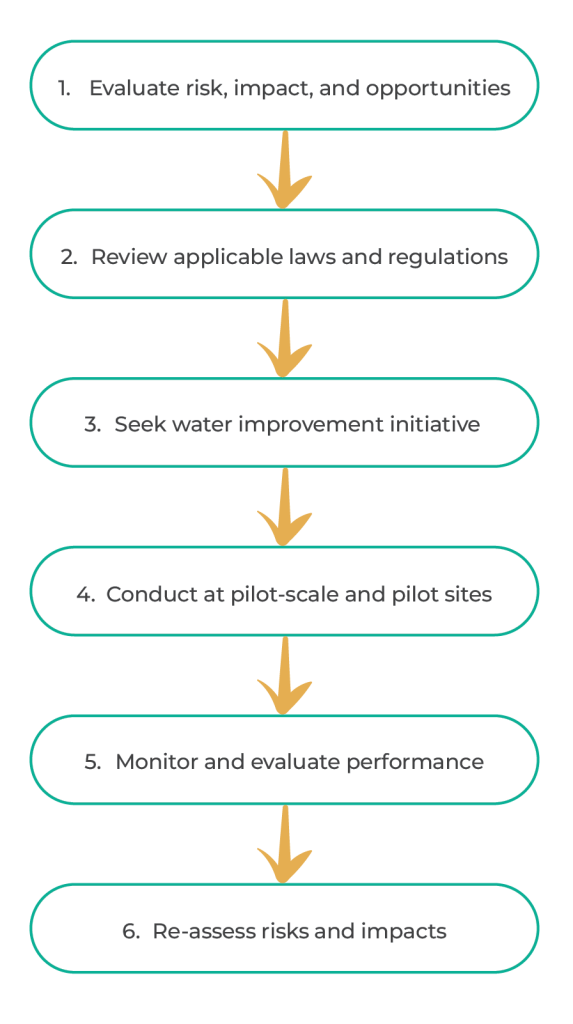
The Company applies a structured annual assessment to identify and evaluate water-related risks and impacts across all operating assets, covering water quantity, quality, and availability under both current and future conditions, including climate and operational scenarios. Internationally recognized tools, including the World Resources Institute (WRI) Aqueduct, environmental impact assessments, and ISO 14046 water footprint assessments, are used to ensure transparent, comparable, and consistent identification of water-related risks and impacts.
To strengthen long-term water stewardship, the Company uses scenario analysis and dynamic water modeling to assess groundwater behavior, site-level water balance performance, and exposure to potential water stress conditions. Our water models, datasets, and assessment outcomes are subject to annual validation and management review, ensuring robust governance, high data quality, and continuous improvement in water-related risk management practices.
Year in Review
In 2025, the Company established water targets for 2026-2030 to reduce water consumption, supported by continuous monitoring against quantified performance indicators. Site-specific initiatives were implemented in alignment with the approved water and discharge management plan, including site-specific water management plans and trigger action response plans (TARPs) for mine water discharges at each underground mine site in Australia.
For mining business, water consumption intensity was 7.5% reduction from 2024. Despite this improvement, the annual target was not met, primarily due to elevated evaporation losses across mining areas. To address this, the Company will refine baseline assumptions, enhance water monitoring systems, and deploy targeted efficiency measures to improve performance and support the achievement of future targets. For thermal power business, the Company achieved the target with a water consumption intensity. Building on this result, the Company remains committed to pursuing further opportunities to optimize operational processes and continuously strengthen water management systems across the portfolio.
 English
  Thai
Thai