Human Rights
Human Rights
Policy & Commitment
Banpu is fully committed to respecting, promoting, and protecting the human rights of all individuals connected with our operations, including employees, suppliers, business partners, communities, and other stakeholders. We safeguard the rights of all people, regardless of race, color, sex, age, language, religion, political opinion, national or social origin, gender identity, sexual orientation, vulnerable status, or any other characteristic, while strictly prohibiting any form of violence, discrimination, harassment, child exploitation, or abuse within our operations. Our practices comply with applicable laws and align with leading international standards, including the Universal Declaration of Human Rights (UDHR), the UN Guiding Principles on Business and Human Rights (UNGPs), the ILO Declaration on Fundamental Principles and Rights at Work, and the OECD Due Diligence Guidelines for Responsible Business Conduct. These human rights principles are embedded across decision-making processes, policies, and practices, and reinforced through continuous employee training and awareness-raising.
Management Approach
The Company consistently prioritizes and safeguards human rights across all business units and throughout our business relationships. Our commitment is reflected in a range of initiatives that uphold human dignity across our operations, products, and services. Human rights considerations are embedded within our enterprise risk management systems. Our Human Rights Policy was first announced in 2016, revised in 2023, and most recently updated in 2025 to reflect the evolving business landscape, stakeholder expectations, and emerging human rights risks. The 2025 Policy comprises 2 main sections: Human Rights Principles, which articulate the Company’s fundamental commitments to all rights holders, and Human Rights Integration, which guide our decision-making, operational practices, and business activities across the value chain.
To translate these commitments into practice, we have developed a Human Rights Due Diligence (HRDD) Manual that provides a structured, UNGP-aligned framework to identify, prevent, mitigate, and account for potential adverse impacts on individuals, communities, and stakeholders. We conduct a comprehensive human rights risk assessment every 3 years across our operations, joint ventures, and supply chain, with particular attention to potentially vulnerable rights holders. Risks identified within the value chain are managed through a structured leverage process, the “Cause/Contribute/Directly Linked framework” (CCL) framework of the UNGPs.
The Human Rights Committee provides company-wide oversight of policy implementation, due diligence processes, and risk management. Accessible and confidential grievance mechanisms are available to both internal and external stakeholders, enabling concerns to be raised and remediated in a timely and transparent manner. All cases are managed under non-retaliation principles, with outcomes monitored by the Human Rights Committee. Mandatory human rights training is delivered to all employees across operations, with enhanced, role-specific modules for higher-risk functions such as procurement, security, and human resources.
Human Rights Due Diligence
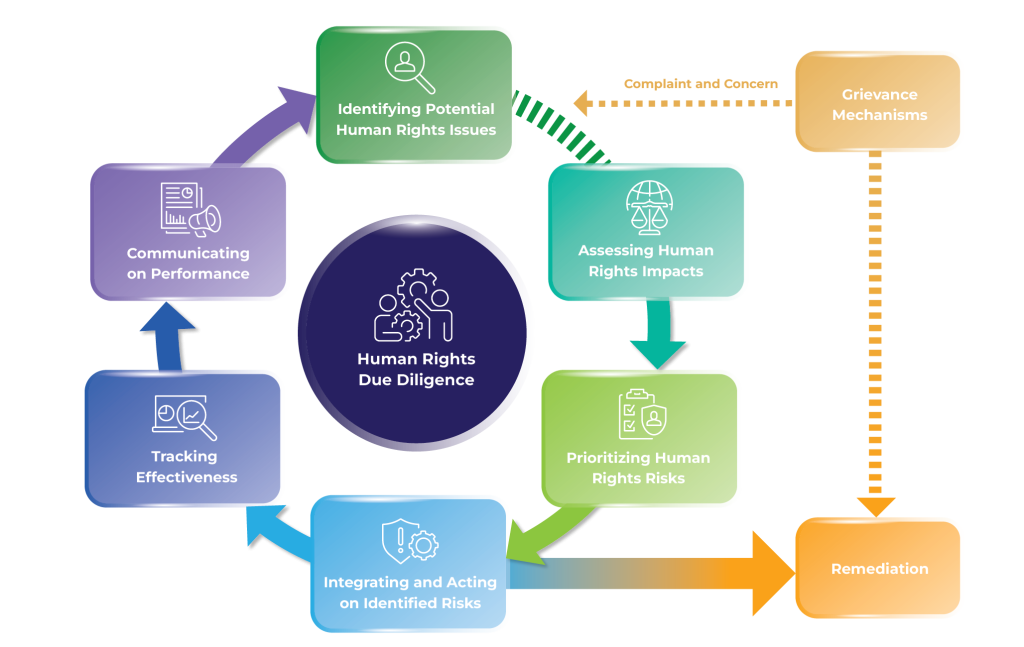
The Company regularly conducts Human Rights Due Diligence (HRDD) to ensure that our operations, supply chains, and business relationships respect and protect the rights of all individuals involved. Guided by Banpu HRDD manual, the process provides a structured framework for identifying human rights issues, assessing impacts, prioritizing risks, monitoring effectiveness, and ensuring clear communication. The process is designed to cease, prevent, and manage potential and actual human rights risks and their impacts.
The Company provides safe and accessible grievance mechanism channels through which internal and external rights-holders can raise concerns or complaints regarding potential human rights violations. In cases where violations cannot be prevented, we are committed to providing appropriate remediation to affected individuals, addressing the root causes, and preventing recurrence. This approach sustains the effectiveness of our human rights initiatives and timely responds to human rights risks, while ensuring we meet and exceed stakeholder expectations, reinforcing our dedication to creating positive and sustainable impacts across all our operations.
Example of Human Rights Issues
Dignity, Equality, and Security
• Discrimination and unequal treatment
• Unfair labor recruitment
• Wage underpayment
• Excessive overtime
• Unfair leave
• Security forces
• Psychosocial impacts
• Violence, bullying, and harassment
• Bribery and corruption
• Interference with Privacy
• Internal grievance mechanisms
• External grievance mechanisms
Labor Rights
• Child labor and exploitation
• Forced labor
• Human trafficking
• Restricted freedom of association and collective bargaining
• Unsafe and unhealthy working environment
Housing, Land Acquisition, and the Environment
• Negative socio-economic impacts to communities
• Absence of community consultation
• Unfair compensation on relocation and land acquisition
• Forced displacement on relocation and land acquisition
• Degradation of a clean and healthy environment
• Insufficient site rehabilitation and closure plans after decommissioning
Community and Cultural Rights
• Absence of Free, Prior, and Informed Consent (FPIC) for Indigenous Peoples
• Insufficient protection of community health
• Cultural heritage impacts
Human Rights Governance
To reinforce strong human rights governance and uphold the highest international standards, the Company has established a Human Rights Committee to provide oversight and strategic direction for the implementation of human rights practices across our operations and supply chain. Operating at a cross-functional management level, the committee includes representatives from key functions across the Company to support effective implementation of human rights policies, risk management, and corrective actions in all aspects. This structure ensures that respect for human rights is embedded into our corporate governance, decision-making processes, and day-to-day operations at every level.
The Human Rights Committee oversees human rights strategies and initiatives, guiding implementation across the organization and providing the necessary support to business units. The responsibilities include monitoring human rights risk assessments conducted every three years, reviewing identified potential and actual impacts, and promoting human rights awareness at all levels through training programs, workshops, and awareness campaigns.
Human Rights Risk Assessment Workshop
The Company has taken meaningful steps to advance human rights across our operations through comprehensive training and workshops, particularly those conducted in Australia and Thailand in 2025. Our training programs equipped employees with deep knowledge of human rights foundation, international standards, and their respective business roles. Building on this foundation, we organized workshops in which key internal stakeholders collaborated to identify human rights issues specific to their operational and local contexts. This collaborative approach was essential for gathering accurate, on-the-ground insights that informed our assessment and prioritization of human rights risks across the Company’s operations. We embed human rights consideration into every aspect of our operations by fostering a culture of respect and responsibility, prioritizing inclusivity, and engaging directly with stakeholders in the communities where we operate.
Human Rights Mandatory Training Course
The Company launched a mandatory human rights training Course, Human Rights 101, to strengthen understanding of human rights principles, internationally recognized standards, our Human Rights Policy, and human rights due diligence processes across operations and the value chain. The course was first rolled out in Thailand in 2025 as the initial phase of implementation, with plans to progressively extend it to other business units across all countries where we operate.
The course addresses key topics including human dignity, the prevention of human rights violations, grievance mechanisms, and the roles and responsibilities of employees in identifying, preventing, and mitigating potential human rights risks. It supports the integration of human rights considerations into day-to-day activities and decision-making, enhances risk awareness, and promotes a culture of respect across all functions. Course completion and quiz results are systematically tracked and recorded to ensure full compliance, evaluate training effectiveness, and inform continuous improvement of our human rights capacity-building efforts.
Year in Review
In 2025, the Company strengthened our human rights governance by establishing a dedicated Human Rights Committee to oversee policy implementation, due diligence, and risk management across the organization. To guide forward action, the Company developed a Human Rights Roadmap 2030 alongside the target for 2026–2030, setting a clearer direction for enhancing human rights management systems and mitigating potential adverse impacts across operations.
During the year, the Company recorded zero significant human rights incidents across all business units. To uphold the highest human rights standards, we conducted comprehensive human rights risk assessments in Australia and Thailand. While most identified issues were assessed as low to medium risk, 5 issues were classified as high-impact and prioritized for mitigation.
To build internal awareness and understanding of basic human rights, the Company published Human Rights 101, a mandatory training course covering basic human rights principles, Banpu’s Human Rights Policy, and the grievance mechanism, with a roadmap to expand to all countries across the Company’s global operations.
In Australia, Banpu Australia published its annual Modern Slavery Statement in accordance with applicable regulatory requirements and international human rights standards. The statement addressed potential modern slavery risks across both local and international supply chain. Based on the review, the overall modern slavery risk within its supply chain was assessed as low.
 English
  Thai
Thai