
Climate Resilience & Adaptation
Climate Resilience & Adaptation


Policy & Commitment
Banpu is committed to building long-term resilience to climate change across our operations, people, and value chain, in accordance with our Climate Change Policy. We seek to reduce vulnerability to climate-related impacts by integrating adaptation into operational planning and asset management. Our approach focuses on strengthening infrastructure resilience, improving water security through conservation and alternative supply measures, applying ecosystem-based solutions where relevant, and reinforcing preparedness for changing climate conditions. We also promote awareness, training, and collaboration with employees, communities, and other key stakeholders to build adaptive capacity and strengthen climate resilience.
Management Approach
Banpu integrates climate resilience and adaptation into strategic planning, operational decision-making, and enterprise risk management. Climate-related risks are assessed across short-, medium-, and long-term horizons and integrated into investment, operational, and business continuity decisions. Oversight is provided by the dedicated Climate Change Committee to ensure implementation across the organization.
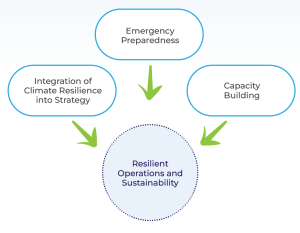
The Company uses climate scenario analysis to stress-test our strategy against plausible futures and to identify adaptation priorities. Where risks are material, we respond through infrastructure upgrades to address physical exposure, diversification of water sources and conservation measures, and ecosystem-based adaptation. Emergency preparedness and business continuity planning are also strengthened to reduce disruption from extreme weather events and long-term climate variability. Banpu further strengthens organizational capacity through climate literacy programs that equip employees to identify risks and apply adaptive practices. Through this approach, we safeguard people, maintain operational stability, and contribute to long-term business resilience.
Impacts, Risks & Opportunities
Impact Materiality
Failure to manage climate risks could lead to environmental disasters, disruption to communities, infrastructure damage, and harm to local ecosystems.
Financial Materiality
Inadequate adaptation to climate risks could result in severe operational disruptions, increased costs, regulatory penalties, asset impairment, and reduced investor confidence.
Climate Change Adaptation Plan
Banpu recognizes that climate change poses increasing physical risks that may affect the resilience and continuity of our operations over the short-, medium-, and long-term. In line with the Company’s Climate Change Policy, a climate change adaptation plan has been established to proactively manage physical climate risks and strengthen long‑term business resilience.
The adaptation plan is informed by physical climate risk assessments covering both acute risks, such as extreme weather events, and chronic risks, including long‑term changes in temperature, precipitation patterns, and water availability. These risks are assessed using recognized climate scenarios and are integrated into the enterprise risk management framework to support strategic planning and decision-making. Key adaptation measures include enhancing asset and operational resilience through infrastructure upgrades, improved water resource management, and the application of nature‑based solutions such as ecosystem conservation and restoration.
The Company also emphasizes operational preparedness, capacity building, and stakeholder engagement with employees and communities to strengthen adaptive capacity. Adaptation measures are regularly reviewed to reflect evolving climate risks and scientific developments.
Policy Influence Related to Climate Change
Banpu engages in public policy dialogue on climate and energy matters in a responsible and transparent manner. This engagement supports a just energy transition and aligns with the goals of the Paris Agreement and relevant national climate frameworks. Our efforts focus on regulatory and policy issues related to climate change, energy transition, decarbonization, and climate related disclosure.
Banpu does not provide any political contributions to political parties, candidates, or campaigns, and we do not retain external lobbyists. We conduct all engagement through lawful and transparent channels, including direct dialogue with regulators on sector specific matters and participation in industry and trade associations in the countries where the Company operates.
Recognizing that association positions may not always align with Banpu’s climate commitments, the ESG Committee oversees an annual review of the public climate-policy positions of associations to which the Company pays material dues. Where material misalignment with the goals of the Paris Agreement or our climate targets is identified, the Company engages with the association to seek change and, if unresolved, considers withdrawal. The outcomes of this review are reported annually in this Sustainability Report. This governance is integrated into our sustainability governance framework and supports the identification and management of climate-related transition risks, consistent with IFRS S2.
Year in Review
In 2025, Banpu strengthened climate resilience and adaptation by completing a comprehensive risk and opportunity assessment and integrating the results into strategic planning. This assessment provided a foundation for prioritizing actions that strengthen resilience and align with long-term goals. Key metrics include the coverage of operating sites with climate-related risk assessments, which reached 83%, reflecting strong and consistent implementation across operations.
At site level, we have invested in upgrading infrastructure to withstand severe weather events, including integrating energy-efficient technologies that meet climate adaptation standards. Recognizing water scarcity as a key risk, we implemented strategies to optimize water use and promote conservation.
We also enhanced our business continuity planning by conducting scenario-based exercises and developing contingency measures to maintain operational stability during natural disasters. These plans include emergency response protocols, resource allocation strategies, and communication frameworks to ensure rapid recovery and minimal disruption. No unforeseen expenses from physical climate‑related disruptions were recorded, demonstrating the effectiveness of preventive risk management measures.
 English
  Thai
Thai