
ESG in Supplier Management
Supply Chain Management

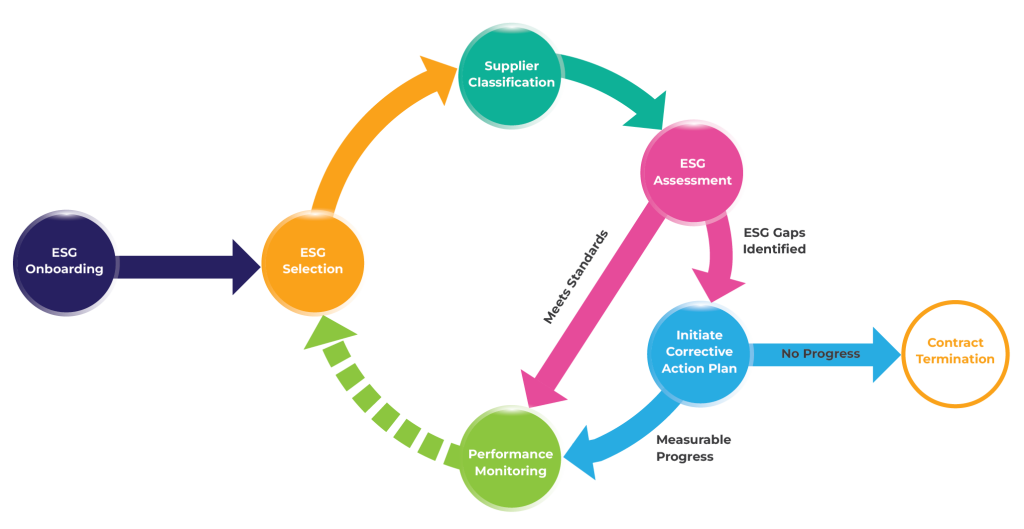
Banpu integrates ESG considerations across the procurement cycle to ensure that all suppliers operate in alignment with the Company’s Supplier Code of Conduct. The approach comprises 4 key steps: ESG Onboarding, ESG Selection, Supplier Classification, and ESG Assessment, reinforcing the Company’s commitment to responsible sourcing and supply chain resilience. The framework draws on internationally recognized references, including ISO 20400 and the UN Guiding Principles on Business and Human Rights. It is designed to address material ESG risks across Tier-1 suppliers and, where relevant, beyond Tier-1 suppliers.
ESG Onboarding
As a prerequisite to procurement engagement, prospective suppliers must complete an ESG onboarding questionnaire covering ESG dimensions. Suppliers are required to acknowledge and commit to Banpu’s ESG expectations, as articulated in the Supplier Code of Conduct. Only those who formally accept these expectations proceed to the selection stage.
ESG Selection
The Company developed ESG selection criteria based on leading practices across industry peers. The criteria evaluate suppliers on key ESG topics, including health and safety, energy, and waste management, human rights, labor practices, regulatory compliance, and business ethics.
Supplier ESG performance is evaluated through a self assessment questionnaire, supported by relevant evidence. The results are incorporated into the supplier selection process to ensure that procurement decisions consider commercial, technical, and ESG factors.
Supplier Classification
Suppliers are classified through a dual-lens approach covering business relevance (e.g., spending, substitutability, and dependency) and ESG risk exposure (e.g., sector, geography, nature of operations, and potential ESG impacts). The significant suppliers, those with material ESG risks, are identified for subsequent in-depth ESG assessments, capacity building, and ongoing monitoring.
ESG Assessment
ESG assessments are conducted to evaluate supplier performance during service delivery, with reference to ISO 20400. The assessments combine desk-based reviews of supplier-submitted data with onsite audits, and may be conducted directly by the Company or, where necessary, by accredited third party auditors to identify actual or potential ESG impacts.
 English
  Thai
Thai