
Climate-Related Targets and Net Zero Ambition
Climate Mitigation
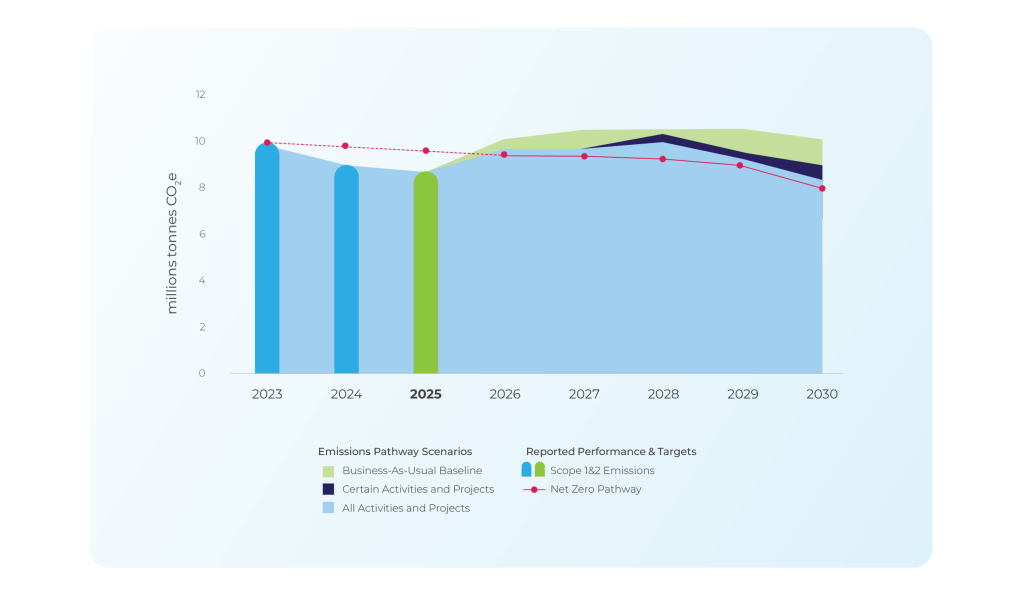
Banpu has committed to achieving Net Zero greenhouse gas (GHG) emissions for Scope 1 and Scope 2 by 2050, with an interim target to reduce absolute Scope 1 and 2 emissions at least 20% by 2030 from a 2023 baseline. The pathway and interim targets were stress‑tested against 1.5 °C‑aligned scenarios, including the IEA NZE scenario, to assess consistency with required decarbonization rates and to identify execution and dependency risks. Alongside these emissions targets, Banpu has set a portfolio transition target for more than 50% of our EBITDA to come from non-coal businesses by 2030. Target and disclosures are developed in alignment with IFRS S2 disclosure principles. In addition, Banpu is expanding our Scope 3 inventory to cover all material categories. This will establish a robust baseline to assess the feasibility of setting a Scope 3 reduction target in future reporting cycles.
To ensure the credibility and integrity of our decarbonization pathway, Banpu engaged an independent third party to assess the technical feasibility and practicality of the planned initiatives under both certain activities and projects, and all activities and projects scenarios. The independent review concluded that the pathway is technically feasible, subject to the timely execution of the identified initiatives and the establishment of supporting enabling conditions. Banpu treats this independent assessment as a baseline rather than a one-time exercise. Targets and the underlying pathway will be reviewed periodically against evolving climate science, regulatory expectations, and operational performance.
Beyond 2030, Banpu aims to achieve Net Zero emissions by 2050 by prioritizing absolute emission reductions over offsetting. The investment decisions are screened using an internal carbon price to reflect the long-term cost of emissions in capital allocation. Residual emissions that cannot be abated within the target horizon will be addressed through a hierarchy of approaches, prioritizing engineered and nature-based removals that meet recognized quality criteria, with verified offsets used only where removals are not yet available at scale. Offset and removal credits will be sourced from projects certified under leading standards and assessed against recognized integrity frameworks.
 English
  Thai
Thai