
Climate Transition Plan

Climate Mitigation
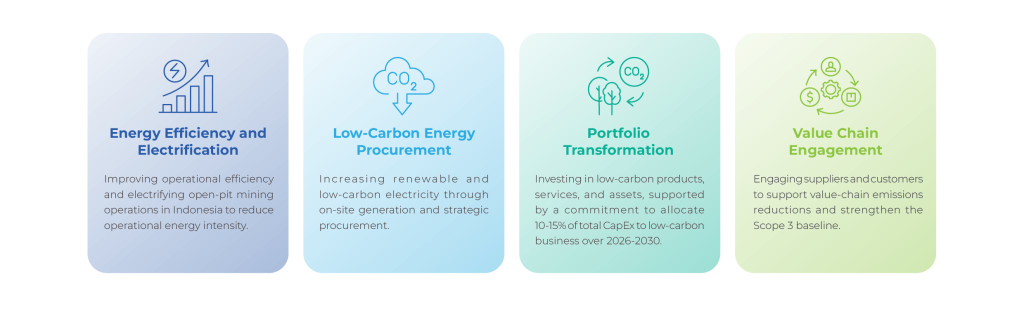
Banpu’s climate transition plan outlines how the Company will achieve Net Zero Scope 1 and 2 emissions by 2050, with an interim target to reduce absolute Scope 1 and 2 emissions at least 20% by 2030 from a 2023 baseline. The plan sets out governance, implementation levers, capital allocation, scenario testing, and monitoring arrangements, and is reviewed and updated annually.

Climate strategy oversight is provided by the Board-level ESG Committee, which quarterly reviews strategy, targets, and progress. The CEO is accountable for execution, supported by the Climate Change Committee, which coordinates deliverables across business units, monitors implementation, escalates material issues to the Board, and ensures alignment with IFRS S2 disclosure expectations. Progress toward the 2030 target is driven by four primary levers.

• Energy Efficiency and Electrification: Improving operational efficiency and electrifying open-pit mining operations in Indonesia to reduce operational energy intensity.
• Low-Carbon Energy Procurement: Increasing renewable and low-carbon electricity through on-site generation and strategic procurement.
• Portfolio Transformation: Investing in low-carbon products, services, and assets, supported by a commitment to allocate 10-15% of total CapEx to low-carbon business over 2026-2030.
• Value Chain Engagement: Engaging suppliers and customers to support value-chain emissions reductions and strengthen the Scope 3 baseline.
Banpu has made no new inorganic investments in coal-related businesses since 2020. While the new coal-related investment has been halted, the Company continues to optimize and manage the existing, high-efficiency coal assets to preserve energy security and financial resilience through the transition. The phase-down is executed in a manner consistent with Just Transition principles, with attention to workforce reskilling, community impacts in host regions, and continued engagement with affected stakeholders.

The plan has been stress-tested against the IEA’s Net Zero Emissions by 2050 and Stated Policies Scenarios, informing capital allocation decisions and identifying locked-in emissions and transition-risk exposures across the portfolio. Key assumptions include internal carbon price trajectories, the evolution of grid emission factor in principal operating geographies, and the cost and availability of low-carbon technologies.

Delivery of the plan is conditional on external factors, including supportive regulatory environments, the pace of renewable electricity availability, and customer-side decarbonization. Banpu is actively working to shape these dependencies through policy engagement in operating jurisdictions, long-term renewable procurement, and customer collaboration programs, rather than treating them as fixed constraints.

Progress against targets, the expansion of Scope 3 inventory, and any changes to targets or methodologies are reported annually in the Sustainability Report and Climate Change Report. The ESG Committee reviews the plan each year and updates it to reflect regulatory developments, evolving climate science, and improvements in emissions data. Where progress deviates from plan, Banpu discloses drivers and our corrective actions.

Feedback